Blog · SEO
SEOMultilingual Website Cyprus: Which Languages Actually Pay
A multilingual website Cyprus businesses actually need starts with English and Greek, not every flag.
 AI-generated
On this page
A multilingual website Cyprus businesses actually need almost always starts with two languages: English and Greek. Not every flag, not a wall of language buttons, just the two that reach most of your real customers. English because a large share of visitors, expats and international buyers use it, and Greek because that is how local people search and decide who to trust. Everything beyond those two is a business decision, not an assumption, and it should be justified by who is actually enquiring, booking and searching. This is an honest breakdown of which languages pay off for a multilingual website Cyprus owners are likely to consider, where they do not pay off, and how to build the thing properly so search engines can read every version.
We are Digital Mind Agency (madevisible.io), a digital marketing agency based in Paphos serving Paphos, Limassol and Larnaca. Oliver and the team build and maintain multilingual sites for the Cyprus market, so what follows is how we think it through with a client, not theory from a slide deck.
Which languages does a multilingual website Cyprus business actually need
Here is the simple way we explain it to clients. The Republic of Cyprus has two official languages, Greek and Turkish, and English is widely spoken. As of 2024, European Commission-derived data puts English knowledge at 66.5% of the population. That figure tells you English is commercially important. It does not tell you an English-only site reaches everyone, because the people who search in Greek, trust a Greek page, and read Greek reviews are a real and separate audience.
So the question of which Cyprus website languages a business site needs does not have one answer for everyone. A Paphos restaurant, a Limassol property company, a Nicosia law firm and a Larnaca airport-transfer service all sit in different markets. The way to decide is to look at where your enquiries come from, which language your reviews are written in, and what people type into Google before they contact you. Add a language because the demand is there, not because the flag looks nice in the header.
Start with English and Greek
For most Republic of Cyprus businesses, a Greek and English site is the sensible starting point. English handles tourists, expats, international B2B and cross-border enquiries. Greek handles local discovery, trust and the households and companies that simply prefer to read in their own language. Get these two right and everything else works harder. Only then do you look at whether a third language earns its place on your multilingual website Cyprus visitors will actually use.
Cyprus is a connected market, so this matters more than it might in a quieter one. There were roughly 1.29 million internet users at the start of 2025, about 94.7% penetration, and in the first quarter of 2025, 88.2% of individuals used the internet to find information about goods or services. That figure is now over 18 months old, but the direction is clear: people research online before they buy, and the language of that research decides whether they find you.
The third language question
Tourism is where the extra languages usually get interesting. Cyprus recorded 4,534,073 tourist arrivals in 2025, up 12.2% on 2024 (source: Cyprus Statistical Service, published 2026). The main source markets were the UK at 31.8%, Israel at 13.0%, Poland at 8.2%, Germany at 6.1%, Greece at 3.9% and Sweden at 3.4%. If you run a hotel, a rental, a tour or a transfer business, that mix is your honest shortlist for a third or fourth language on a multilingual website Cyprus tourism operators need, not a random pick.
German is worth assessing for hospitality, property and retirement-related services. Polish is worth checking for seasonal tourism. Russian can matter for property, finance and relocation in specific areas, but validate it with current enquiry data rather than treating it as automatic. Turkish is an official language and relevant if you serve a Turkish-speaking audience. Hebrew is a possible opportunity given Israel's share, though it needs right-to-left design and native-language quality control. None of these should be added on a hunch.
Translation is not multilingual SEO
 AI-generated
This is the part most people get wrong, so it is worth being plain about it. Running your pages through an automatic translation plugin is not multilingual SEO Cyprus standard work. It gives you words in another language, but it does not give you pages that rank, and it often creates pages Google cannot read as separate versions. The effort goes in and the results quietly leak out, because the underlying structure that search engines rely on simply is not there.
Real multilingual SEO Cyprus work means each language gets its own keyword research, its own titles and meta descriptions, its own headings and internal links, and its own quality review. Search intent, terminology, spelling and formality all differ by language. You do not translate an English keyword word-for-word and hope; the phrase people actually type in Greek or German may be structured completely differently. Do the research per language or the translation quietly wastes the money you spent on it.
Not sure where your site stands?
A free first consultation, no slides and no pressure. You leave with the three things to fix first.
Book a free consultation →What actually needs translating
Not every page. Start with the pages that carry commercial value or search demand: core services, locations, product or room pages, booking and contact pages, and any articles that already perform well. A thin, half-translated site full of empty pages helps no one. It is better to have twenty solid pages in two languages than a hundred machine-translated ones nobody trusts.
On translation quality, we are open about how we work. English and German are our native working languages, written and maintained in-house. Further languages such as Greek, Polish, Russian and French are delivered through AI translation plus a structured review pass, and we recommend a native check on top for legal texts and high-stakes sales copy. The honesty is the point: automatic translation is fine for a first draft, but the pages that win or lose a customer deserve human eyes.
The technical part: hreflang and URLs
Here is where the plumbing matters. Getting hreflang Cyprus setups right is the part that separates a multilingual site that ranks from one that merely looks multilingual. A language switcher in the header does not, on its own, create indexable language pages. Flags in a corner are cosmetic. What actually tells Google you have a proper multilingual website Cyprus search engines can read is separate, crawlable URLs plus the correct signals connecting them. Get the plumbing wrong and Google may treat your Greek and English pages as duplicates, or ignore one entirely.
Google recommends giving each language its own URL, using a folder structure such as /en/, /el/ and /de/, then adding hreflang annotations. The hreflang tag simply tells Google which language or regional version of a page is meant for which audience. The rule that trips people up: every version must reference itself and every other version, with fully qualified, crawlable URLs. A hreflang Cyprus setup is reciprocal or it does not work.
What a correct setup looks like
A clean setup has three things working together. First, separate indexable URLs per language: one page per language, never one page that swaps text with a script. Second, reciprocal hreflang so the English, Greek and any other version all point to each other. If you later target region-specific variants, such as Greek for Greece versus Greek for Cyprus, the hreflang region attribute handles that distinction cleanly. Third, an XML sitemap that lists every version so search engines find them without difficulty. Google supports hreflang through HTML, HTTP headers or the sitemap, so pick one method and stay consistent.
Two smaller points that matter for Cyprus website languages. Each language needs its own meta title, description, headings and image alt text, written for that language and its search intent, not copied across. And use language names in your switcher where you can, not flags alone: a flag represents a country, not a language, and it confuses users who speak the same language in different places. A concrete example of good switcher labelling is "EL / Ελληνικά" rather than a Greek flag icon. A well-structured multilingual website Cyprus businesses maintain over time also needs its own Search Console reporting per language: set up a separate view or reporting segment per language after launch so you see clicks, impressions and enquiries by market, because a language that gets traffic but no bookings is telling you something. If you want the wider picture of how these pages then compete, our guide to ranking on Google in Cyprus covers what happens once the multilingual structure is sound.
How to build a multilingual website Cyprus tourism businesses actually need
 AI-generated
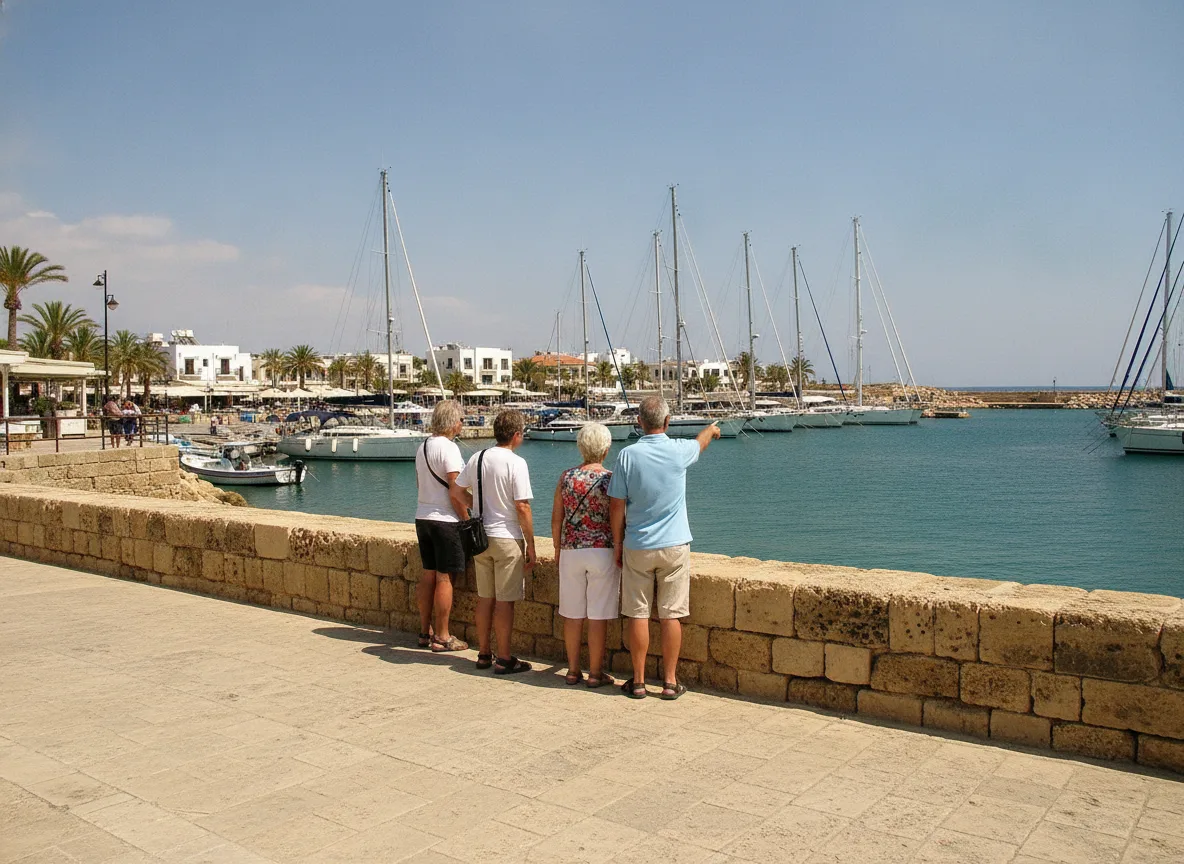
If you are working out how to build a multilingual website Cyprus tourism operators actually need, the process is the same as for any business but the language shortlist is driven harder by your visitor mix. Start with English and Greek, then let the 2025 arrivals data guide the next choices: German for the German market, Polish for Polish visitors, Hebrew where Israeli guests are a meaningful share, and so on. Build only the pages guests actually use in each language: rooms or services, availability and booking, location and how to reach you, and clear contact details.
The sensible order for any multilingual website Cyprus project looks like this:
- Decide languages from your own enquiry, booking and review data, plus the source-market figures, so every language you add has a clear audience behind it.
- Build English and Greek fully, with proper per-language keywords, metadata and content, because these two reach the broadest share of your real customers before any further investment.
- Set up the technical layer: separate URLs, reciprocal hreflang and a complete sitemap, so search engines can find and distinguish every version.
- Add each further language one at a time, translated with a review pass and a native check on the pages that close a sale, so quality stays consistent as the site grows.
Doing it in that order means you never pay for pages that no one visits.
On cost, we will not hand you a single number, because it would be dishonest. The price depends on page count, how many languages, the CMS, translation quality, SEO setup, integrations and ongoing maintenance. A two-language site with twenty core pages is a very different job from a five-language hotel site with a booking engine. If budgeting is your main concern, our breakdown of monthly SEO cost in Cyprus and the wider Cyprus SEO services overview show how the ongoing side of the work is priced. For the strategic choice between organic and paid reach across languages, see SEO vs paid ads in Cyprus.
One last honest note. The market is not fully covered: in 2025, 70.7% of enterprises with ten or more employees had a website, which means plenty of businesses still run thin or single-language sites. A well-built multilingual website Cyprus visitors can actually read in their own language is a genuine advantage here, not because it is fancy, but because so many competitors have not bothered to do it properly. If you want a second pair of eyes on your setup, Oliver and the team are happy to look. You can read more about how we work at Digital Marketing Agency Cyprus.
If you are not sure which languages your site actually needs, or whether the technical side is set up correctly, tell us your problem and we will hand you the specific solution for it. We will review your current setup and tell you which languages are worth adding and which are not. The first consultation is free, with no slides and no pressure.
Book the free first consultation
FAQ
Should my Cyprus website be in Greek or English?
For many businesses, both is the strongest starting point. English handles international customers, tourists and expats; Greek handles local discovery, trust and Greek-speaking customers. English proficiency in Cyprus is high, around 66.5% as of 2024, but that does not remove the need for a proper Greek version for the people who search and decide in Greek.
What is hreflang and do I need it?
Hreflang is a signal that tells Google which language or regional version of a page is meant for which audience. If your multilingual website Cyprus setup has more than one language, you need it. Every version must reference itself and every other version with fully qualified, crawlable URLs, or the setup does not work properly.
Does translating a website improve Google rankings?
Translation alone does not guarantee rankings. Each language needs useful, localised content, its own search-intent research, indexable URLs, internal links, metadata and technical signals. Machine-translated pages with no per-language keyword work rarely rank, even when the words are correct.
Which languages should a Cyprus hotel website use?
Start with English and Greek, then use your visitor-market data to assess German, Polish, Hebrew, Russian or others. The 2025 tourism mix, with the UK at 31.8%, Israel at 13.0%, Poland at 8.2% and Germany at 6.1%, is a rational starting shortlist, but your own booking and enquiry data should make the final call.
Want a brand that is impossible to ignore?
We build the software, sites and systems that put you in front of the right people. One free call, one clear next step.
Book a free consultation →